
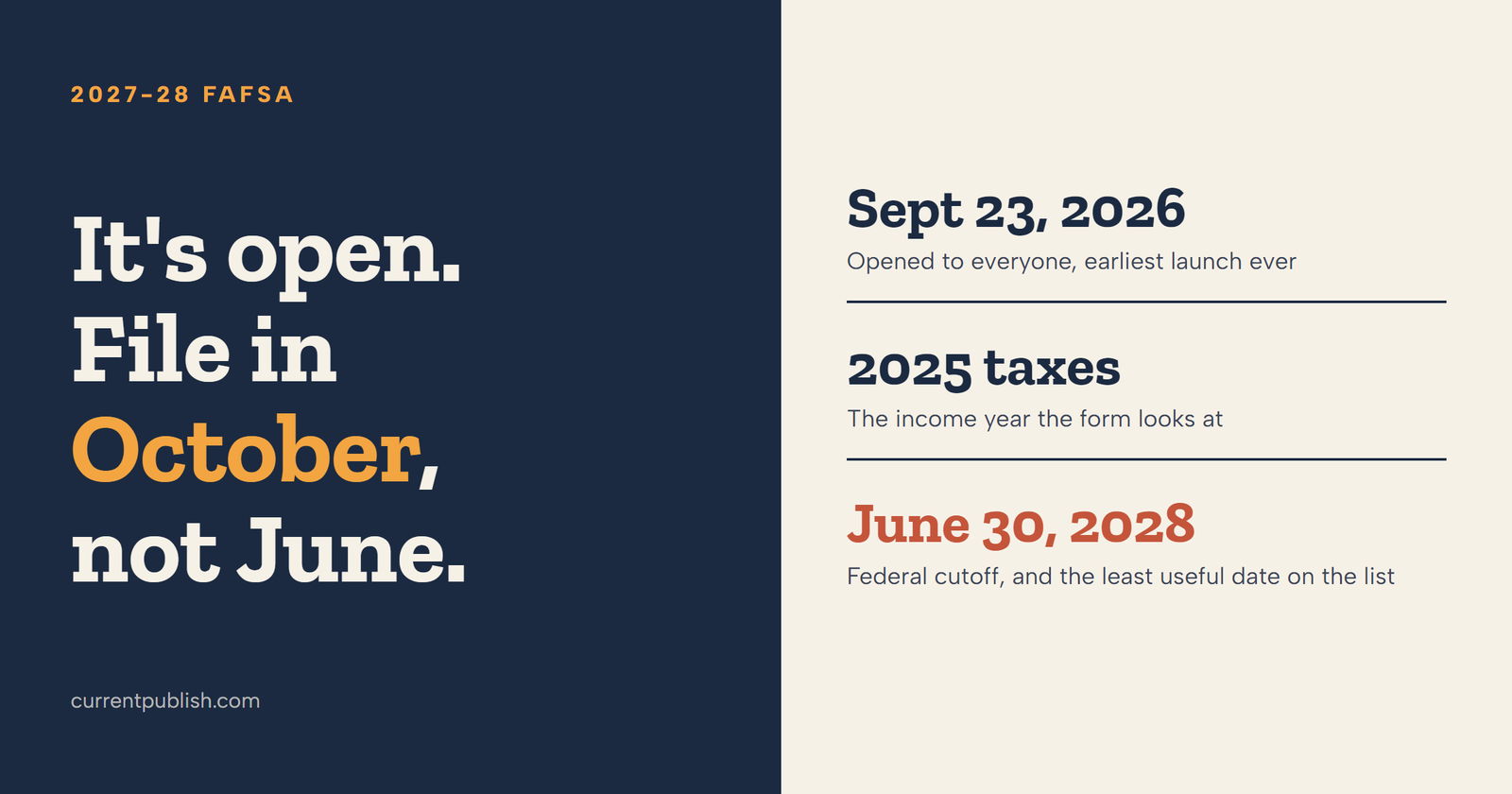
The 2027-28 FAFSA is live. It opened to everyone on September 23, 2026, the earliest launch the form has ever had, and it covers college from July 1, 2027 to June 30, 2028. If you’re starting college next fall or already in school and want aid again, this is the form.
The official federal deadline is June 30, 2028. Ignore it. That date mostly protects your access to federal loans. The money that doesn’t need paying back (state grants, school grants, a lot of scholarships) runs on much earlier deadlines, and some of it is first come, first served. Here’s what you need to know, what changed, and what to do this week.
The short version
- It’s open now at studentaid.gov, and it’s free. Any site charging you to file it is not the FAFSA.
- It uses your 2025 taxes, not 2026. Those numbers are already final.
- File in October if you can. Most state and college priority dates fall between January and March 2027.
- Pell and loan rules changed in 2026 under the One Big Beautiful Bill Act, and those changes carry into this form.
- Everyone involved needs their own StudentAid.gov account, and that’s where most people get stuck.
2027-28 FAFSA key dates
| Date | What happens |
|---|---|
| August 2026 | Early testing opens to a limited group of students |
| September 23, 2026 | Form opens to everyone |
| January to March 2027 | Where most state grant and college priority deadlines land |
| July 1, 2027 | The 2027-28 aid year starts |
| June 30, 2028 | Final federal deadline to submit |
If you filed during the early testing period, you’re done. The Department of Education says those beta submissions count and you don’t need to file again.
What’s different on the 2027-28 FAFSA
The form itself
The big redesign happened a few years ago, so this year’s form will feel familiar. What’s new is mostly speed. Most forms are processed right away, a few take one to three days, and you can now see an estimate of your Pell Grant eligibility as soon as you submit instead of waiting weeks.
The rules behind it
The bigger changes come from the One Big Beautiful Bill Act, signed July 4, 2025. They kicked in with the 2026-27 aid year and carry over to this one. According to NASFAA’s breakdown of the Pell changes:
- High Student Aid Index (SAI) = no Pell. If your SAI is at least twice the maximum Pell Grant, you’re out. For 2026-27 that cutoff was an SAI of 14,790 (twice the $7,395 max). The 2027-28 max Pell hadn’t been announced when we checked, so the new cutoff isn’t set yet.
- Full ride = no Pell. If outside scholarships already cover your full cost of attendance, your Pell Grant drops to zero.
- Foreign income counts. Foreign earned income that used to be excluded now gets added back in when figuring Pell eligibility. Some families who got Pell before will lose it.
- Family farms and small businesses don’t count as assets. Same goes for family-owned commercial fisheries. That’s good news for a lot of families.
Student loans changed too
If you or your parents plan to borrow, the rules are different for anyone taking out new loans after July 1, 2026.
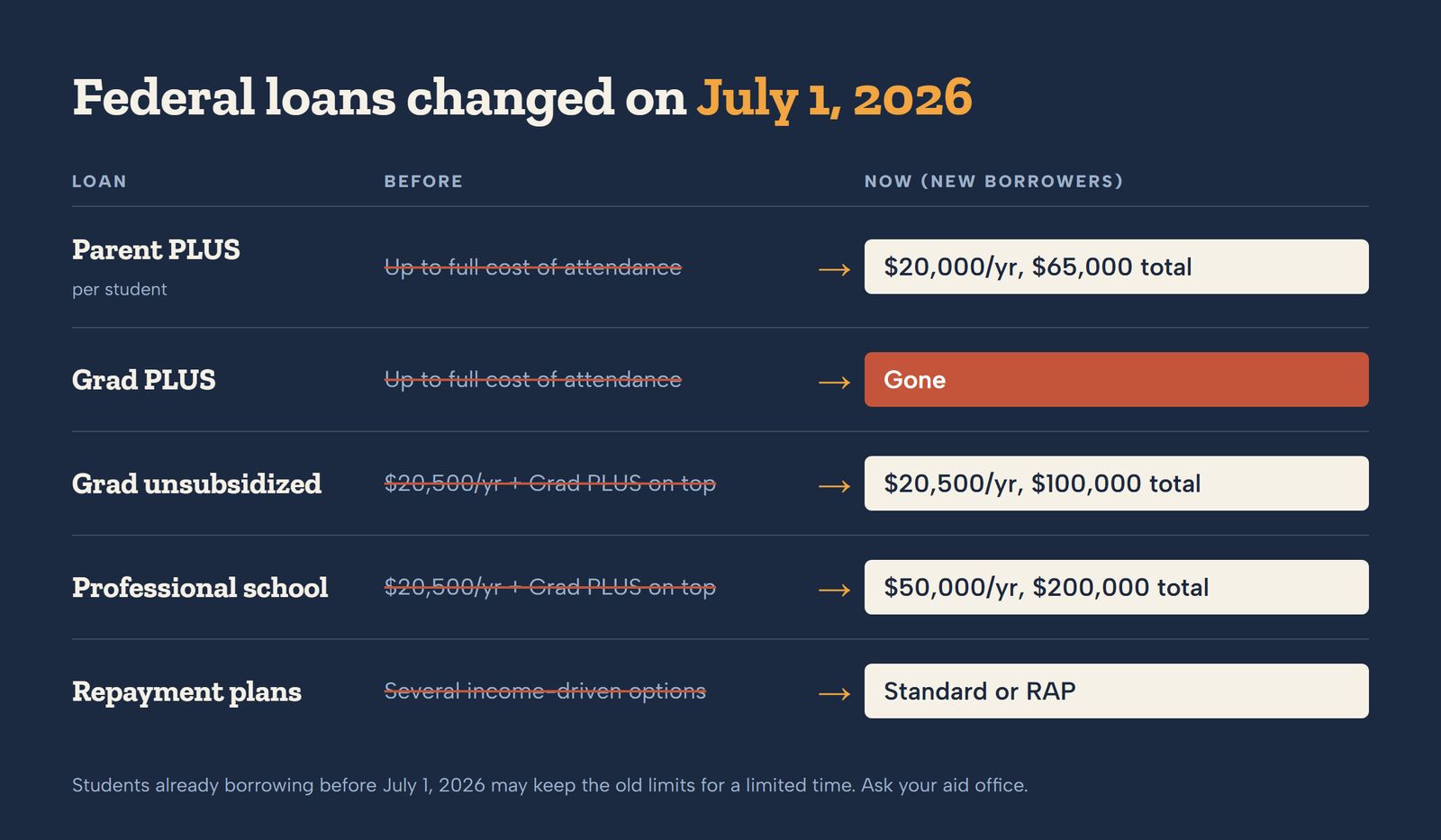
- Parent PLUS is capped at $20,000 a year and $65,000 total per student. It used to go all the way up to the full cost of attendance.
- Grad PLUS is gone for new borrowers.
- Grad students can borrow up to $20,500 a year, with a $100,000 total limit. Professional students (law, medicine and similar) get $50,000 a year, with a $200,000 total limit.
- Repayment for new loans comes down to a standard plan or the new Repayment Assistance Plan (RAP).
Already borrowing for a program you started before July 1, 2026? You may be able to keep the old limits for a while. Ask your school’s financial aid office what applies to you.
Why the federal deadline is a trap
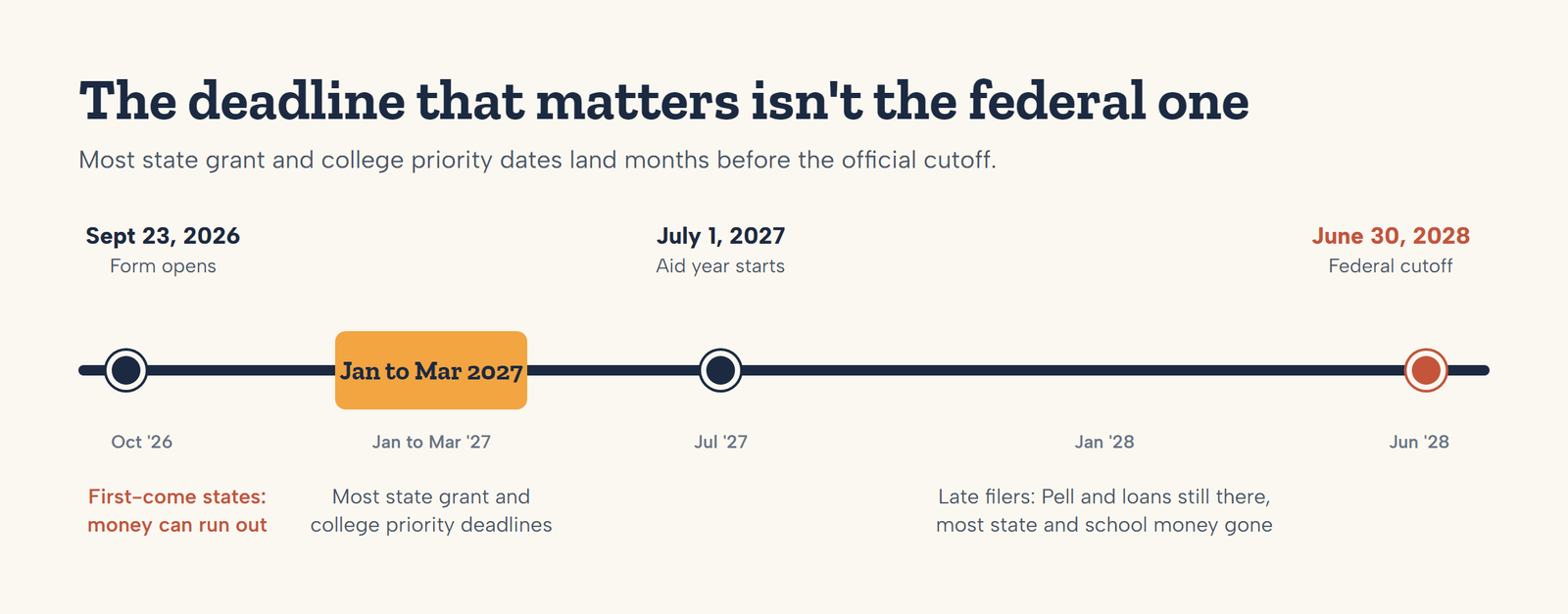
There are three kinds of deadlines, and you need to hit the earliest one that applies to you:
- Federal: June 30, 2028. If you file this late you can still get Pell and federal loans, but that’s about it.
- State: Usually between January and May 2027. Several states, including Illinois and Kentucky, have historically handed out grant money first come, first served, so the real deadline is whenever the money runs out. California’s Cal Grant date is listed as March 2, 2027, so confirm it with the California Student Aid Commission before you count on it.
- College: Each school sets its own priority date, often between November 2026 and early March 2027. Miss it and you can drop to the back of the line for that school’s own grants.
You can look up your state’s date on the official FAFSA deadlines page. Your school’s date is on its financial aid page. If you’re still building your list, our guide to getting into top universities lines up the admissions side of the same calendar.
What to gather before you start
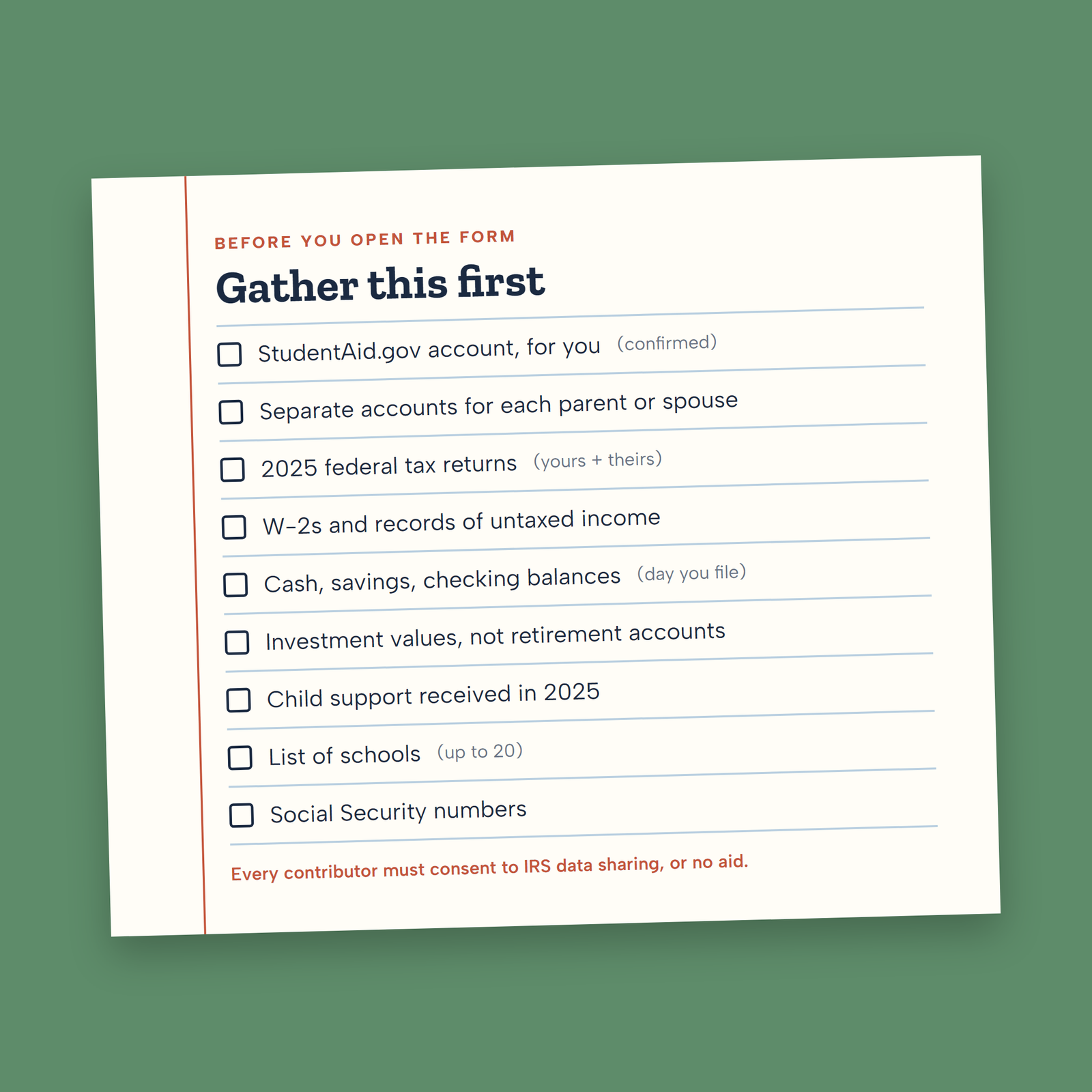
- A StudentAid.gov account for you, plus a separate one for each contributor (usually your parents if you’re a dependent student, or your spouse if you’re married). Every account has to be verified against Social Security records, which can take a few days. Create yours here.
- 2025 federal tax returns for you and each contributor. Most of the numbers transfer straight from the IRS once everyone gives consent.
- Records of untaxed income, like child support you received.
- Current balances for cash, savings and checking, plus investment values, as of the day you file. Retirement accounts and the home you live in don’t count.
- Your school list. You can send the FAFSA to up to 20 schools.
How to file, step by step
- Create and verify your StudentAid.gov account, and get every contributor to do the same this week.
- Log in at studentaid.gov and start the 2027-28 form.
- Invite your contributors using their name, date of birth, Social Security number and email.
- Give consent for the IRS to share your tax info. Every contributor has to do this too. If anyone skips it, you won’t get an aid calculation.
- Add your schools, starting with the ones that have the earliest priority dates.
- Sign and submit. You’ll see your estimated Pell eligibility right away. Your FAFSA Submission Summary follows, usually within one to three days.
Mistakes that cost people money
- Waiting for spring. Your 2025 taxes are already filed, so there’s nothing to wait for.
- Parents sharing one account. Each contributor needs their own login, and they can’t use yours.
- Listing retirement savings as assets. 401(k)s and IRAs stay off the form.
- Not filing because you think you earn too much. Plenty of colleges use the FAFSA for their own merit aid, and you need it to get federal loans at all.
- Paying someone to file. The form is free.
After you submit
Read your FAFSA Submission Summary and fix any mistakes. If your school picks you for verification, send what they ask for quickly, since your aid won’t come through until you do. Once aid offers arrive in spring 2027, compare what you’d actually pay at each school, not just the size of the grants. Our breakdown of college costs, unfiltered walks through how to read those numbers. To save on what aid doesn’t cover, see where to find cheaper college textbooks.
Aid rules, award amounts and state deadlines can change. Everything here was checked on October 5, 2026. Always confirm dates with StudentAid.gov, your state’s aid agency and your school’s financial aid office before you rely on them.
2027-28 FAFSA FAQ
When did the 2027-28 FAFSA open?
The 2027-28 FAFSA opened to everyone on September 23, 2026, after a limited early testing period that started in August 2026.
What is the deadline for the 2027-28 FAFSA?
The federal deadline is June 30, 2028, but state and college deadlines come much sooner, mostly between January and March 2027. File as early as you can.
Which tax year does the 2027-28 FAFSA use?
The 2027-28 FAFSA uses 2025 federal tax information for you and any contributors.
Do I need to refile if I submitted during the beta test?
No. The Department of Education says submissions made during early testing are valid, so you do not need to file again.
Who counts as a contributor on the FAFSA?
A contributor is anyone whose information the form needs, usually your parents if you are a dependent student or your spouse if you are married. Each one needs their own StudentAid.gov account and must consent to sharing their tax information.
Can I lose my Pell Grant under the new rules?
Yes. Under the One Big Beautiful Bill Act, you are not eligible for a Pell Grant if your Student Aid Index is at least twice the maximum Pell award, if outside scholarships already cover your full cost of attendance, or in some cases because foreign earned income is now added back in.
What is the maximum Pell Grant for 2027-28?
The 2027-28 maximum had not been announced as of October 5, 2026. The 2026-27 maximum was $7,395.
How long does the FAFSA take to process?
Most forms are processed right away, and some take one to three days. You can see an estimate of your Pell Grant eligibility as soon as you submit.
Is there still a Grad PLUS loan?
Not for new borrowers. Grad PLUS ended on July 1, 2026. Graduate students can now borrow up to $20,500 a year with a $100,000 total limit, and professional students up to $50,000 a year with a $200,000 total limit.
Is the FAFSA free?
Yes. The FAFSA is always free on StudentAid.gov. Any site that charges you to file it is not the official form.